ASU, Dreamscape Learn bring immersive VR biology classrooms to Phoenix school district

Pendergast Elementary eighth grader Camilo Cruz (center) tries the new Dreamscape Learn mobile virtual reality classroom at Pendergast Community Center in Phoenix on Wednesday. Photo by Samantha Chow/Arizona State University
Camilo Cruz adjusted the strap on his virtual reality headset, grabbed the black joystick in front of him and, with a point of his index finger, punched in the four-digit code.
Immediately, he was transported to a colorful and vibrant immersive biology curriculum set inside an intergalactic wildlife refuge. He watched as alien creatures ate from trees with bright orange foliage and huge animals called megaraffs — they look like dinosaurs but have giraffe colorings — moved together in a herd.
It's part of Dreamscape Learn’s immersive STEM curriculum, co-developed to great success with Arizona State University, which combines cinematic storytelling with proven active-learning techniques to deepen engagement and improve outcomes. The sights and sounds of the space-based sanctuary kept Cruz's attention as he was taught biology concepts such as cell signaling, genetics and adaptation.
“I feel like learning biology in a book would have just been boring,” said Cruz, an eighth grade student at Desert Mirage Elementary School in the Pendergast Elementary School District, on the west side of metro Phoenix.
“Sitting in a class all day wouldn’t have been very exciting for me. But with Dreamscape, it really let me feel like I was already a biologist in a way. It was very hands-on. That’s why I really liked it.”
Or, as Garden Lakes Elementary eighth grader Addi Ranney put it, the experience is “super sick.”
Cruz and Ranney were among the students on hand Wednesday for the ribbon cutting of the first of two Dreamscape Learn mobile pods. The 16-seat mobile classroom, custom-fitted inside a 46-foot towable trailer, will rotate around the district's 12 schools and will be available to Pendergast Elementary’s 3,000 middle school students in sixth, seventh and eighth grades.
Pendergast, which has had a Dreamscape lab inside Villa de Paz Elementary School since 2024, is the first K–8 public school district in the nation to deploy a Dreamscape Learn mobile classroom, and the first to bring the experience districtwide.

Pendergast Superintendent Jennifer Cruz thanked Dreamscape Immersive and ASU, which owns the pods, for their partnership and work in bringing the VR learning platform to her district.
“I want to express my deep gratitude for their innovation, their commitment and their belief in what’s possible,” said Cruz, who has three degrees from ASU. “Dreamscape Learn taps into this thing that makes us human. It’s what makes us unique, our capacity for empathy and our boundless imagination. It inspires (students) to explore and wonder and see themselves as scientists, adventurers and creators.
“For us, this isn’t just a ribbon cutting. It’s a commitment to innovation, to partnership and to prepare every single learner for what’s to come in their future.”
ASU President Michael Crow, noting that the university launched its first Dreamscape Learn curriculum in 2022 and now operates labs on the Tempe and Polytechnic campuses, as well as the MIX Center in Mesa, called the VR learning platform a “magic wand” in bringing teaching up to the speed in which knowledge is being advanced.
“What it means now is that every kid in this district will have access to the most advanced learning tool that humans have ever created,” Crow said. “Process that for a second. Anyone can dream about whatever they want to do, and they can find a way to do it. They can dream about how to learn because learning is activated in a way that you learn from other people in a lived experience. We’ve never had a way to teach biology that way. We’ve never had a way to teach chemistry that way. We’ve never had a way to teach astronomy that way.
“So how about everyone has an opportunity to understand who we are, what we are, where we are, and you can do anything you want. That’s what this moment is about.”
Cruz said she first heard about Dreamscape Learn when the CEO of the Glendale Chamber of Commerce told her she had to see it. Cruz was skeptical at first — “they’re playing video games with college kids. I’m sure it’s fantastic for them,” she said — but after some research decided to visit Dreamscape Learn at ASU.
Once she experienced it herself, she was convinced it could help her students.

“When you go have this experience, if you’ve spent any time with kids, you can completely see how gamification pedagogy would meet the needs of middle school kids,” she said. “So, we actually brought students to ASU for them to experience Dreamscape Learn.
“Parents and then lots of staff members were concerned that I had finally actually lost my crackers. (But) it’s a no-brainer, once you have that experience.”
Josh Reibel, CEO of Dreamscape Learn, said the virtual reality platform fulfills what his company considers a prime driver for student success: engagement.
“This is a really about a very significant step in rethinking of what children’s education can be,” Reibel said. “We have known for millennia that story is what people lean into. We’re all addicted to episodic Netflix stories. We have known since the dawn of time that the one thing that gets humans to feel like, ‘I can’t wait to find out what happens next’ is a good narrative.
“We are taking them to amazing places and putting them in the context of really emotionally compelling stories, where there is real drama and twists and turns and surprises. And you hook them.”
MacKenzie Skarlupka, who teaches seventh and eighth grade science at Villa de Paz, told the audience that since the fixed pod was brought to campus last year, attendance on days it’s used has increased to 90%.
“Students are more motivated, and their excitement continues beyond the classroom through ongoing science discussions,” Skarlupka said. “What’s most inspiring is how deeply our students are connecting with the aliens who experience living the science instead of just studying it.”
-

“Dreamscape Learn taps into this thing that makes us human. It’s what makes us unique, our capacity for empathy and our boundless imagination. It inspires (students) to explore and wonder and see themselves as scientists, adventurers and creators,” Pendergast Elementary School District Superintendent Jennifer Cruz said during the Nov. 19 unveiling of ASU and Dreamscape Learn’s mobile virtual reality classroom at Pendergast Community Center in Phoenix on Nov. 19.
Photo by Samantha Chow/Arizona State University
-

ASU President Michael Crow (center), educators and students clap after the ribbon is officially cut Wednesday. Attendees got the chance to go inside the trailer and see the Dreamscape curriculum in action.
Photo by Samantha Chow/Arizona State University
-

Dreamscape Learn CEO Josh Reibel says the virtual reality platform fulfills what his company considers a prime driver for student success: engagement. “This is a really about a very significant step in rethinking of what children’s education can be,” he said at Wednesday's event. “We are taking them to amazing places and putting them in the context of really emotionally compelling stories, where there is real drama and twists and turns and surprises. And you hook them.”
Photo by Samantha Chow/Arizona State University
-

Inside the mobile classroom, there's room for 16 students to take part in the virtual biology curriculum. Here, eighth grader Lewis Calamity gives the classroom a go at the ribbon cutting Wednesday.
-

ASU President Michael Crow speaks with Pendergast Elementary eight grader Joaquin Sevastian Rendon at Wednesday's ribbon cutting for Dreamscape Learn’s mobile virtual reality classroom at Pendergast Community Center.
Photo by Samantha Chow/Arizona State University
-

Pendergast Elementary School District eighth graders show some Sun Devil spirit inside the new Dreamscape Learn mobile virtual reality classroom Wednesday. The pod rotates among the district's 12 schools, so all its middle schoolers can take part in the immersive biology lab.
Photo by Samantha Chow/Arizona State University
At ASU, a study in fall 2022 showed that students in Dreamscape Learn courses were 1.7 times more likely to receive an “A” grade in their lab assignments, with a median score of 96%. Students were also highly engaged in the content, rating the experience an average 4.4 out of five. A later, larger-scale study found similarly positive outcomes.
Lisa Flesher, the chief of Realm 4 Initiatives at ASU, where she helps guide technology-enhanced projects, said a university Institutional Review Board will study data from the Pendergast District this academic year to assess Dreamscape’s effectiveness. She said the data, if positive, will help Dreamscape’s efforts to promote the platform to other school districts across the U.S.
“The data is what sells the folks every time,” Flesher said. “They can go through the experience. They love it. They see the value in it. But when we can walk through the data and say students rate it a five out five and are 1.7 times more like to earn an “A” compared to how we used to teach it … those are the things that make people go, ‘Oh, crap, they’ve made it fun and they’re doing really well.’”
Superintendent Jennifer Cruz has no doubt what the numbers will eventually say.
“My service is about children, and what children need to be prepared for their future,” she said. “They need science content. They need technical content. They need to experience motivation. They need to experience pride in hard work. And all that is possible when we can engage them fully.
“So, that’s what this is about for us. It’s just giving our students every possible opportunity to really, deeply learn important information that’s critical. Facts about science, facts about the natural world, in a way that’s really compelling for them so that they can actually learn it, they retain it and they keep it with them moving forward.”
Related
More Science and technology

New research by ASU paleoanthropologists: 2 ancient human ancestors were neighbors
In 2009, scientists found eight bones from the foot of an ancient human ancestor within layers of million-year-old sediment in the Afar Rift in Ethiopia. The team, led by Arizona State University…

When facts aren’t enough
In the age of viral headlines and endless scrolling, misinformation travels faster than the truth. Even careful readers can be swayed by stories that sound factual but twist logic in subtle ways that…
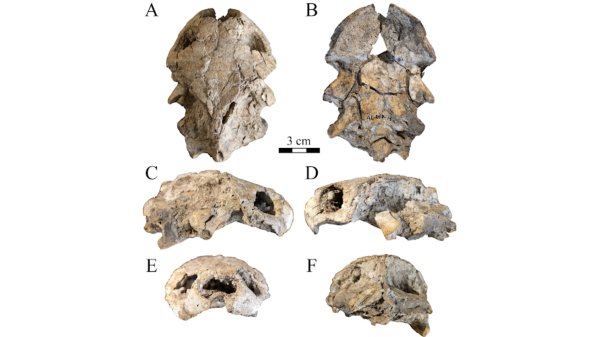
Scientists discover new turtle that lived alongside 'Lucy' species
Shell pieces and a rare skull of a 3-million-year-old freshwater turtle are providing scientists at Arizona State University with new insight into what the environment was like when Australopithecus…